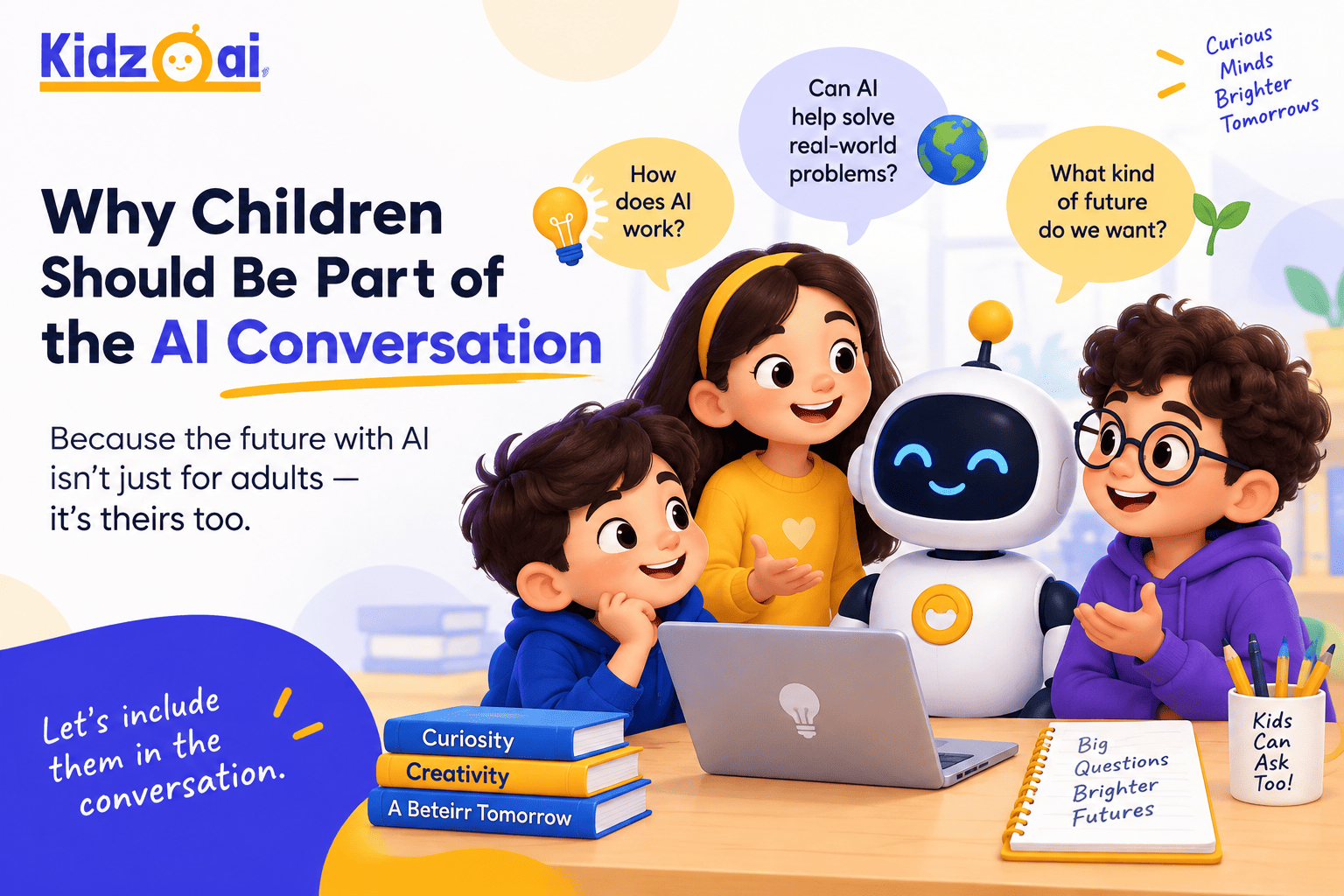
Artificial intelligence is no longer something that belongs only in technology labs or science-fiction movies. It is already part of everyday life. Children encounter AI through search engines, recommendation systems, educational apps, games, voice assistants, and increasingly, tools they use for schoolwork.
Yet, many conversations about artificial intelligence still happen around children rather than with them.
Parents worry about screen time. Teachers wonder how AI will change education. Schools are developing policies around AI tools. Technology companies are building products specifically for younger users. But children themselves—the generation that will grow up alongside these technologies—also need a place in the conversation.
The goal isn't to turn every child into an AI expert or programmer. It is to help children understand the technology they are already using, question it thoughtfully, and learn how to use it responsibly.
Children Are Already Growing Up With AI
For today's children, AI is not a distant concept. It can influence what videos appear in their feeds, help answer questions, recommend games or music, translate languages, recognize speech, and power many of the digital tools they use every day.
This makes AI literacy increasingly important.
Just as children learn that information on the internet isn't automatically true, they should also learn that an AI-generated answer isn't automatically correct. AI can produce useful information, but it can also misunderstand a question, make mistakes, or present incorrect information confidently.
A child who understands this difference is better prepared to use technology thoughtfully rather than simply accepting whatever it produces.
Why Children Need to Understand AI, Not Just Use It
There is an important difference between using AI and understanding AI.
A child may know how to ask an AI chatbot to write a paragraph. But AI literacy goes further. Children can learn to ask:
- Where did this information come from?
- Could the answer be wrong?
- Why did the AI give this particular response?
- Should I use this answer without checking it?
- Is it appropriate to share this personal information?
- What part of the work should I do myself?
These questions encourage critical thinking.
AI education can therefore become less about teaching children a particular tool and more about developing habits that will remain useful even as technology changes.
What Should Children Actually Learn About AI?
Children don't need complicated mathematics or advanced computer science to begin understanding AI. The concepts can be introduced gradually and through examples that relate to their lives.
| AI Concept | What Children Can Learn |
|---|---|
| How AI learns | AI systems use data and patterns to produce results. |
| AI mistakes | AI can give incorrect or incomplete answers. |
| Bias | AI can reflect problems or biases present in its data. |
| Privacy | Personal information should be handled carefully. |
| Critical thinking | AI responses should be questioned and verified. |
| Responsible use | AI should support learning, not replace thinking. |
| Creativity | AI can be used as a tool for exploring and creating ideas. |
The emphasis should be on understanding, questioning, and experimenting, rather than memorizing technical definitions.
AI Education Doesn't Mean Every Child Needs to Become a Programmer
One common misconception is that teaching children about AI means immediately teaching them complex programming.
Programming can certainly be a valuable part of AI education, but it is only one part of the picture.
For children who are interested in coding, learning Python for kids can provide a practical foundation for understanding how computers follow instructions, process information, and solve problems.
For other children, AI education might begin with conversations, creative projects, simple experiments, or understanding how recommendation systems work.
The important thing is to give children opportunities to explore technology at a level appropriate for their age and interests.
Learning AI Through Curiosity and Experimentation
Children naturally learn by asking questions and trying things out. AI education can take advantage of that curiosity.
Instead of starting with complicated technical terminology, educators and parents can give children simple challenges:
- Can AI recognize different objects?
- Can it create a story from three random ideas?
- Can you find an error in an AI-generated answer?
Activities like these turn AI from an abstract concept into something children can investigate.
There are also plenty of AI experiments kids can try without advanced coding . Such activities can help children understand AI through hands-on learning rather than simply reading about it.
The goal isn't always to get the "right" answer. Sometimes the most valuable part is asking why the technology behaved the way it did.
AI Can Influence Children's Development
AI has the potential to change how children learn, create, communicate, and solve problems. Used thoughtfully, it can provide new ways to explore subjects, generate ideas, receive explanations, and experiment with concepts.
At the same time, excessive dependence on AI can create challenges. If children use AI to complete every task without thinking, they may miss opportunities to practise problem-solving, writing, creativity, and independent reasoning.
This is why the conversation shouldn't be framed simply as "AI is good" or "AI is bad."
The more useful question is: How should children use AI so that technology supports their development rather than replacing important learning experiences?
Our detailed discussion on the impact of AI on children's development explores this question further.
The Role of Parents and Teachers
Children don't need adults to have every answer about AI. In fact, learning together can be one of the most effective approaches.
Parents and teachers can:
- Ask children how they use AI. Understanding their existing habits is a good starting point.
- Encourage verification. Teach children to check important information using reliable sources.
- Discuss privacy. Explain why personal details, photographs, passwords, and sensitive information should not be casually shared with AI tools.
- Use AI collaboratively. Instead of allowing AI to complete an assignment, parents and teachers can encourage children to use it for brainstorming, questioning, or exploring alternative explanations.
- Talk about mistakes. When AI gives an incorrect answer, use it as a learning opportunity.
- Keep human judgment at the centre. AI can provide suggestions, but children should learn to make decisions using their own reasoning and values.
Most importantly, children should feel comfortable asking questions about AI without being made to feel that they are "using technology incorrectly."
Preparing Children for an AI-Powered Future
We cannot know exactly what artificial intelligence will look like when today's children enter the workforce. The tools will change. New technologies will emerge. Some jobs will evolve, while entirely new roles may appear.
But certain abilities are likely to remain valuable: curiosity, creativity, communication, critical thinking, adaptability, and the ability to make thoughtful decisions.
That is why children should not simply be taught how to use AI.
They should be invited to ask what AI can do, what it cannot do, when it should be trusted, when it should be questioned, and how humans should remain responsible for the decisions they make with it.
Including children in the AI conversation today isn't about preparing them for one particular technology.
It is about helping them become informed, curious, and responsible participants in a world where AI will increasingly be part of everyday life.
Frequently Asked Questions
How will artificial intelligence affect children?
Artificial intelligence can affect children in several ways, particularly in education, entertainment, communication, and how they access information. It can provide personalized learning support and new creative opportunities, but children may also become overly dependent on AI or encounter inaccurate information. Teaching children critical thinking and responsible AI use can help them benefit from the technology while understanding its limitations.
How would I explain AI to a child?
A simple way to explain AI is to compare it with learning from examples. You could say: "Artificial intelligence is technology that can learn patterns from information and use those patterns to perform tasks or make predictions." For younger children, everyday examples such as voice assistants, recommendation systems, image recognition, and chatbots can make the idea easier to understand.
Why should AI be allowed for students?
AI can be a useful educational tool when students use it appropriately. It can help explain difficult concepts, generate ideas, provide different perspectives, and support creative projects. However, students should not use AI as a replacement for learning or independent thinking. Clear guidance from parents, teachers, and schools is important so that AI becomes a learning aid rather than a shortcut.
How can we protect our children from AI?
Protecting children does not necessarily mean keeping them completely away from AI. A more practical approach is to teach them how to use it safely. Parents and educators can discuss privacy, misinformation, age-appropriate tools, responsible use, and the importance of verifying information. Children should also understand that they can ask a trusted adult when they encounter something confusing or inappropriate online.