A few years ago, if a child said, “I asked AI to explain my homework,” it would have sounded unusual.
Today, it barely raises an eyebrow.
Children are already using artificial intelligence to ask questions, solve maths problems, write stories, learn coding, create images, translate languages, and explore subjects they find interesting. For many of them, AI is becoming as familiar as search engines and smartphones.
And that brings us to a question that parents, teachers, and educators are increasingly asking:
Is AI helping children grow—or are we making them too dependent on it?
The honest answer is: it can do both.
AI can make learning more personal. It can encourage curiosity and help a child understand something that seemed difficult five minutes earlier. It can also become a shortcut that does the thinking for them.
So the conversation shouldn't be about whether children should use AI.
It should be about how we teach children to use it wisely.
How Is AI Changing the Way Children Learn?
Think about a child who is struggling with fractions.
In a classroom, the teacher may explain the concept once, twice, or several times. But the child may still feel uncomfortable saying, “I didn't understand.”
With an AI tool, that child can ask for another explanation.
“Explain fractions using a pizza.”
“Give me a simple example.”
“Explain it like I'm in Class 5.”
“Give me a question to practise.”
Suddenly, learning becomes more interactive.
This is one of the most exciting possibilities of AI in education. Children don't all learn at the same speed or in the same way, and AI can sometimes adapt an explanation to what a learner needs at that moment.
There is another benefit that is easy to overlook.
AI gives children permission to ask questions.
A student who is shy in a classroom may feel more comfortable asking an AI tool the same question several times until the idea finally makes sense.
That can build confidence.
But there is a catch.
If the child asks AI to solve every problem instead of trying first, the same technology that could have helped them learn can actually prevent learning.
There is a big difference between:
“Solve this for me.”
and:
“Give me a hint so I can solve it.”
The second approach keeps the child's brain involved. And that distinction matters.
AI Has Benefits, but It Also Has Risks
It is tempting to look at AI as either a miracle for education or a threat to childhood.
Neither view is particularly helpful.
The reality is much more balanced.
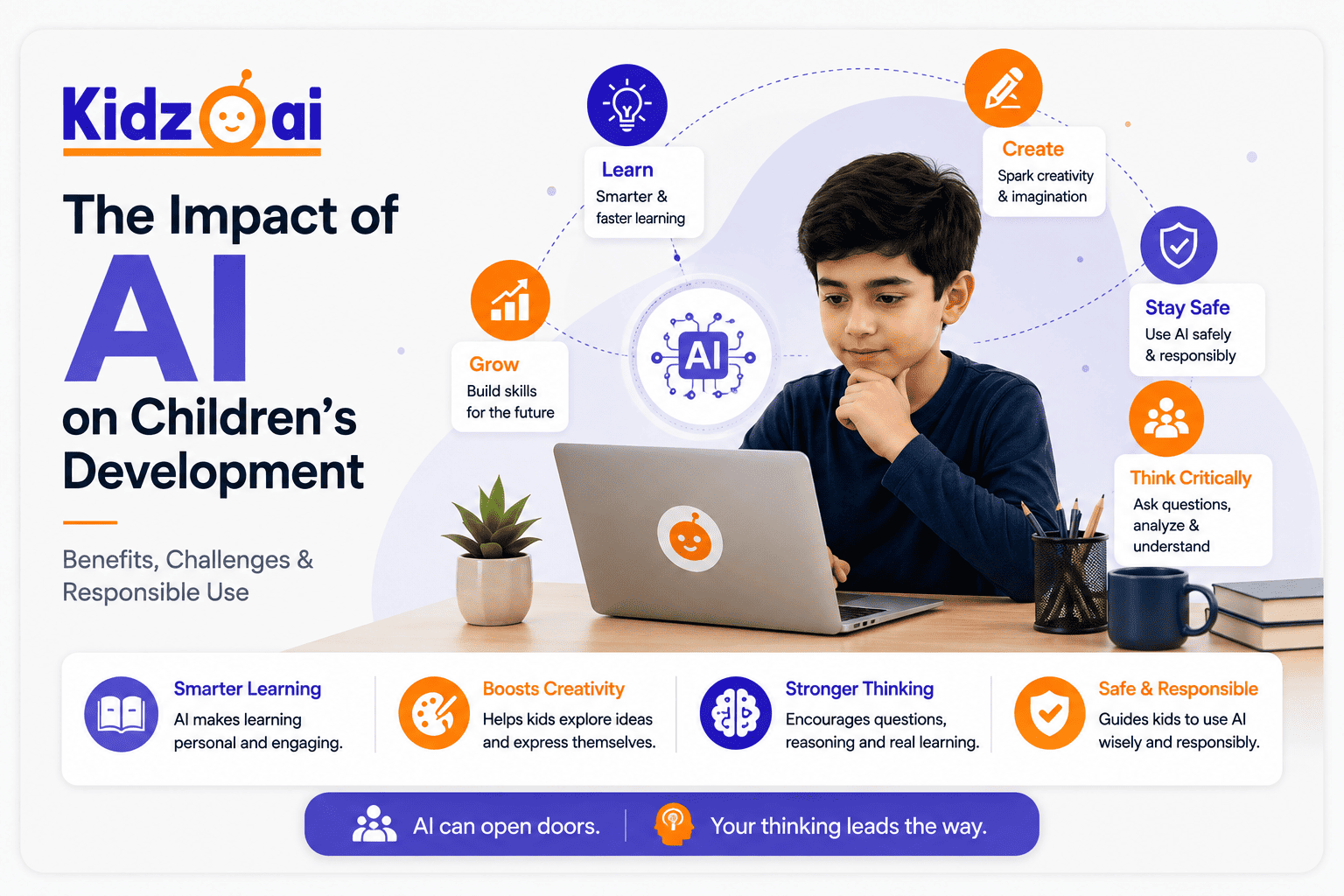
AI can help children explore new subjects, practise skills, generate ideas, receive explanations, and become familiar with technology that will likely be part of their future.
But there are concerns too.
A child may start depending on AI for homework. They may believe an incorrect answer simply because it sounds convincing. They may share personal information without understanding the consequences. Or they may spend so much time interacting with digital tools that important offline experiences get pushed aside.
For a broader look at both sides of the conversation, explore Kidzo AI's guide on the benefits, challenges, and opportunities of AI for kids .
The point isn't to scare children away from AI. It is to help them understand that powerful tools need responsible users.
Benefits and Risks of AI for Children
| Potential Benefits | Possible Risks |
|---|---|
| Personalised explanations | Dependence on AI for answers |
| Encourages curiosity | Reduced independent thinking |
| Supports creativity | Copying AI-generated content |
| Helps children practise skills | Incorrect or misleading information |
| Introduces children to future technologies | Privacy and online safety concerns |
| Can make learning more interactive | Excessive screen dependence |
Can AI Make Children More Creative?
This is where things get interesting.
Children already have incredible imaginations. Give a ten-year-old a cardboard box and you might get a spaceship, a robot, a house, or an entire imaginary city.
AI can add another layer to that creativity.
A child might have an idea for a story but not know how to begin. AI can help brainstorm characters.
A student might have an idea for a science project but be unsure how to present it. AI can suggest different approaches.
A child interested in art can experiment with visual ideas that would have been difficult to create before.
Used this way, AI can be a wonderful creative partner.
But I would draw a line here.
Don't let AI become the creator while the child simply presses the button.
If AI writes the complete story, creates every image, chooses the characters, and makes every decision, the child isn't really creating anymore.
A better approach is:
- Child: Creates the initial idea
- AI: Provides suggestions
- Child: Makes the decisions
- AI: Provides assistance
- Child: Creates the final work
That keeps imagination in the driver's seat.
The Most Important Skill in the AI Age: Critical Thinking
There is something every child needs to learn before becoming comfortable with AI:
AI can be wrong.
And sometimes, it can be wrong while sounding completely confident.
That's a problem.
Imagine a child asks an AI tool a history question and receives a beautifully written answer containing an incorrect fact. If the child assumes that good writing automatically means good information, they may never question it.
This is why AI education should not only teach children how to use AI.
It should teach them how to question AI.
Questions Children Should Learn to Ask
- How do we know this is true?
- Can we find another reliable source?
- Does this answer make sense?
- Can I explain this answer in my own words?
- What happens if the AI is wrong?
These questions are bigger than AI.
They prepare children for the internet, social media, online advertisements, videos, and almost every other source of information they will encounter.
In an AI-powered world, knowing how to think may be more important than knowing where to find an answer.
Will AI Make Children Dependent?
This is probably one of the biggest concerns parents have.
And honestly, it deserves attention.
If a child reaches for AI every time something becomes difficult, they may slowly develop an unhealthy habit:
Difficulty → AI → Answer → Move on.
But learning doesn't work that way.
Struggle is part of learning.
Sometimes a child needs to sit with a difficult problem for ten minutes. They need to make a wrong attempt, find the mistake, try again, and eventually experience that satisfying moment when everything clicks.
We shouldn't remove all of that struggle.
Instead, AI can be used as a support system.
Healthy vs. Unhealthy AI Use
| Healthy AI Use | Unhealthy AI Use |
|---|---|
| Asking AI for a hint | Copying the complete answer |
| Using AI to brainstorm ideas | Letting AI create everything |
| Checking AI-generated information | Believing every AI response |
| Learning from an explanation | Using AI to avoid difficult thinking |
| Creating something original | Submitting AI-generated work as your own |
| Using AI with appropriate guidance | Sharing private information with AI |
A simple approach children can follow is:
- Try the problem yourself.
- If you're stuck, ask AI for a hint.
- Try again.
- Ask AI to explain the mistake if necessary.
- Solve the problem yourself.
That's a much healthier relationship with technology.
The goal isn't for AI to become the child's brain.
The goal is for AI to become a learning assistant.
AI Safety Is Part of Growing Up in a Digital World
There is another conversation that cannot be ignored: safety.
Children need to understand that an AI tool isn't the same as a trusted adult.
They shouldn't casually share passwords, home addresses, private photographs, phone numbers, or sensitive family information.
They also need to understand that not everything AI generates is appropriate, accurate, or suitable for their age.
But safety conversations don't need to sound like a list of scary rules.
Simple AI Safety Rules for Children
- Think before you share.
- Check before you believe.
- Protect your personal information.
- Don't blindly trust AI-generated answers.
- Ask a trusted adult when something feels confusing or inappropriate.
Parents looking for practical ways to introduce AI while keeping children safe can also read this parent's guide to safe and responsible AI use .
The earlier children develop these habits, the easier it becomes for them to navigate an increasingly AI-powered world.
What Should Parents and Teachers Do?
The easiest response to new technology is often to ban it.
But banning AI completely may not prepare children for the world they are actually going to enter.
Instead, adults can teach children how to use it responsibly.
For example, instead of telling a student:
“Never use AI for your project.”
A teacher could say:
“Use AI to brainstorm three ideas. Now research those ideas, choose one, and explain it in your own words.”
That's a completely different learning experience.
The child is still thinking.
The child is still researching.
The child is still making the final decision.
AI simply becomes one part of the process.
A Simple AI Checklist for Parents and Teachers
- Is the AI tool appropriate for the child's age?
- Does the child understand that AI can make mistakes?
- Is the child using AI to learn or simply to get answers?
- Is personal information being kept private?
- Does the child still spend enough time reading, playing, and interacting offline?
- Can the child explain the work without relying on AI?
- Is AI helping the child become more independent rather than more dependent?
AI Shouldn't Replace Childhood
There is one thing we should be especially careful about.
AI should never become a replacement for real childhood.
Children still need to run outside.
They need to play with other children.
They need to read physical books.
They need to have conversations.
They need to make mistakes.
They need to build things with their hands.
They need to experience boredom.
And yes, they sometimes need to struggle with a problem without immediately asking a machine for help.
AI can explain how to communicate.
But it cannot replace a real conversation with a friend.
AI can suggest a science experiment.
But it cannot replace the excitement of actually doing it.
AI can help write a story.
But it cannot provide the personal memories and experiences that make a child's story truly theirs.
Technology should add to childhood, not take childhood's place.
Preparing Children for a Future With AI
Children growing up today will probably work with AI in ways that we cannot completely predict yet.
Some of the jobs they eventually choose may not even exist in their current form.
That doesn't mean every child needs to become a programmer or AI engineer.
What children need is something more fundamental.
They need to know how to learn, question, create, adapt, and use technology responsibly.
AI literacy should therefore become part of a child's broader education.
5 Simple Rules for Children Using AI
- Try first, ask AI later. Give yourself a chance to solve the problem before asking for help.
- Ask for explanations, not just answers. Understanding the process is more valuable than getting the final answer.
- Check important information. AI can make mistakes, so verify facts when accuracy matters.
- Protect your privacy. Never casually share passwords, addresses, private photographs, phone numbers, or other sensitive information.
- Keep creating yourself. Use AI for ideas and support, but let your own imagination and decisions shape the final work.
These small habits can gradually build something much more valuable than technical knowledge alone: confidence in using technology without becoming dependent on it.
The Future Isn't AI vs. Children
The debate around AI and children is sometimes framed as a choice:
AI or childhood.
But it doesn't have to be that way.
The real challenge is finding the balance.
Children should be able to benefit from technology while continuing to develop the qualities that make them human:
- Curiosity
- Creativity
- Empathy
- Imagination
- Communication
- Problem-solving
- Independence
AI can help a child find information. But the child should learn how to judge that information.
AI can provide an idea. But the child should decide what to do with it.
AI can explain a difficult concept. But the child should still do the thinking.
That's the future we should aim for—not children who know how to ask AI for everything, but children who know when AI can help and when they need to think for themselves.
Because ultimately, the goal of education isn't to create children who can produce answers faster.
It is to create children who are curious enough to ask better questions, confident enough to explore, and thoughtful enough to know when an answer needs to be questioned.
And perhaps that is the most important lesson we can teach children in the age of artificial intelligence:
Use AI as a tool. Never let it replace your thinking.
Frequently Asked Questions
How does AI affect children's development?
AI can affect several areas of children's development, including learning, creativity, problem-solving, digital skills, and independence. When used appropriately, AI can provide personalised explanations and encourage curiosity. However, excessive reliance on AI may reduce opportunities for children to practise independent thinking and problem-solving.
Is AI good or bad for children?
AI is neither completely good nor completely bad for children. Its impact depends on how it is introduced and used. Responsible use can support learning and creativity, while excessive or unsupervised use can create concerns around dependency, misinformation, privacy, and screen time.
Can AI improve children's learning?
Yes. AI can provide explanations, examples, practice questions, brainstorming support, and personalised learning assistance. However, children learn best when they remain actively involved. AI should help a child understand a concept rather than simply provide the final answer.
Can AI make children less creative?
It can if children use AI to do all their creative work. If a child relies on AI to write every story or generate every idea, they may have fewer opportunities to develop their own imagination. When used for brainstorming, experimentation, and inspiration, AI can instead help children explore more creative possibilities.
How can parents help children use AI safely?
Parents can establish age-appropriate boundaries, discuss online privacy, encourage children to verify AI-generated information, and make sure technology doesn't replace reading, play, social interaction, or independent problem-solving. Parents should also encourage children to ask questions about AI responses rather than automatically trusting them.