Artificial Intelligence, or AI, is already a part of children's digital world, and it is here to stay. Children come across AI in educational apps, voice assistants, chatbots, search engines, YouTube recommendations, games, and many other digital platforms.
This naturally raises an important question for parents: Is AI safe for children ?
Like any technology, AI can be useful when children are taught how to use it safely and responsibly. It can help children understand difficult concepts, explore new subjects, develop ideas, and broaden their creativity.
But access to AI tools should not come before understanding AI safety.
For parents, the goal should not simply be to give children access to AI. It should be to teach them how AI works, when to use it, what to question, and how to protect themselves while using it.
What Is AI for Kids?
In simple terms, AI for kids means teaching children about artificial intelligence in a way that is simple, understandable, age-appropriate, and connected to things they already experience.
Artificial Intelligence refers to technology that enables computers to perform tasks that involve some form of human-like intelligence.
These tasks can include recognizing patterns, understanding language, answering questions, identifying images, making suggestions, and creating content.
Children may already be interacting with AI without realizing it. Here are a few everyday examples:
- YouTube: AI helps recommend videos based on viewing activity.
- Voice assistants: AI helps interpret spoken language and respond to questions.
- Educational apps: Some apps use AI to personalize or adapt learning experiences.
- Search engines: AI helps understand what people are searching for.
- Games: Some games use AI to make characters and gameplay more responsive.
Helping children understand the technology they use can make it easier for them to use it thoughtfully instead of treating it like magic.
Why Should Kids Learn About Artificial Intelligence?
Children don't need to become AI experts. However, understanding the basics of AI can help them become safer, more informed, and more responsible technology users.
AI Is Everywhere
AI is becoming part of everyday experiences at school, at home, and eventually in the workplace. Understanding it early can help children become more confident when using new technologies.
AI Can Be a Learning Buddy
When used properly, AI can support a child's learning by explaining difficult concepts, providing examples, answering questions, and creating practice activities.
For example, a child struggling with a science topic could ask AI to explain it in simpler language.
AI Can Encourage Curiosity
AI can help children explore a wide range of topics. A simple question about space, animals, history, science, or technology can become the starting point for further learning.
But curiosity should always be combined with another important skill: knowing when to question the answer.
Is AI Safe for Children?
AI can be beneficial for children, but safe AI use requires guidance.
One common mistake is assuming that AI will always provide correct information. AI can make mistakes. Sometimes it may give an incorrect answer, misunderstand a question, or present information confidently even when the information is not accurate.
There are other concerns parents should understand:
- Children may accidentally share personal or school-related information.
- AI may provide incorrect or misleading answers.
- Children may become too dependent on AI.
- Using AI to complete homework can encourage academic dishonesty.
- Some AI tools may produce content that is inappropriate for children.
- Children may stop evaluating information independently if they accept every AI answer without questioning it.
The goal does not necessarily have to be keeping children away from AI completely. Instead, parents can teach children how to use AI safely, responsibly, and effectively.
How Can Kids Safely Use AI for Learning?
If children remain actively involved in the learning process, AI can be a useful learning tool.
For example, instead of asking AI to complete an assignment, a child could ask:
“Can you explain photosynthesis in simple words?”
Or:
“Can you create five quiz questions to help me practice fractions?”
Or:
“Can you explain the meaning of this word and give me three examples?”
AI can be used to:
- Practice English vocabulary
- Create quiz questions
- Develop ideas for a story
- Explore science topics
- Practice mathematics
- Understand new concepts
- Create writing prompts
- Explore different explanations of a topic
The important difference is between using AI to support learning and using AI to avoid learning.
Should Kids Use AI for Homework?
This is one of the biggest concerns for parents.
AI can help children with homework, but the final answer should not simply be copied and pasted from an AI tool.
Not a Helpful Approach
“Generate my entire science project.”
A Better Approach
“Explain this science principle and give me some project ideas that I can explore myself.”
The second prompt encourages the child to participate in the learning process and develop their own understanding.
A useful rule for children is:
Use AI for practice, understanding, and exploration—not to think for you.
Parents can also encourage children to follow their school's rules regarding AI use for assignments.
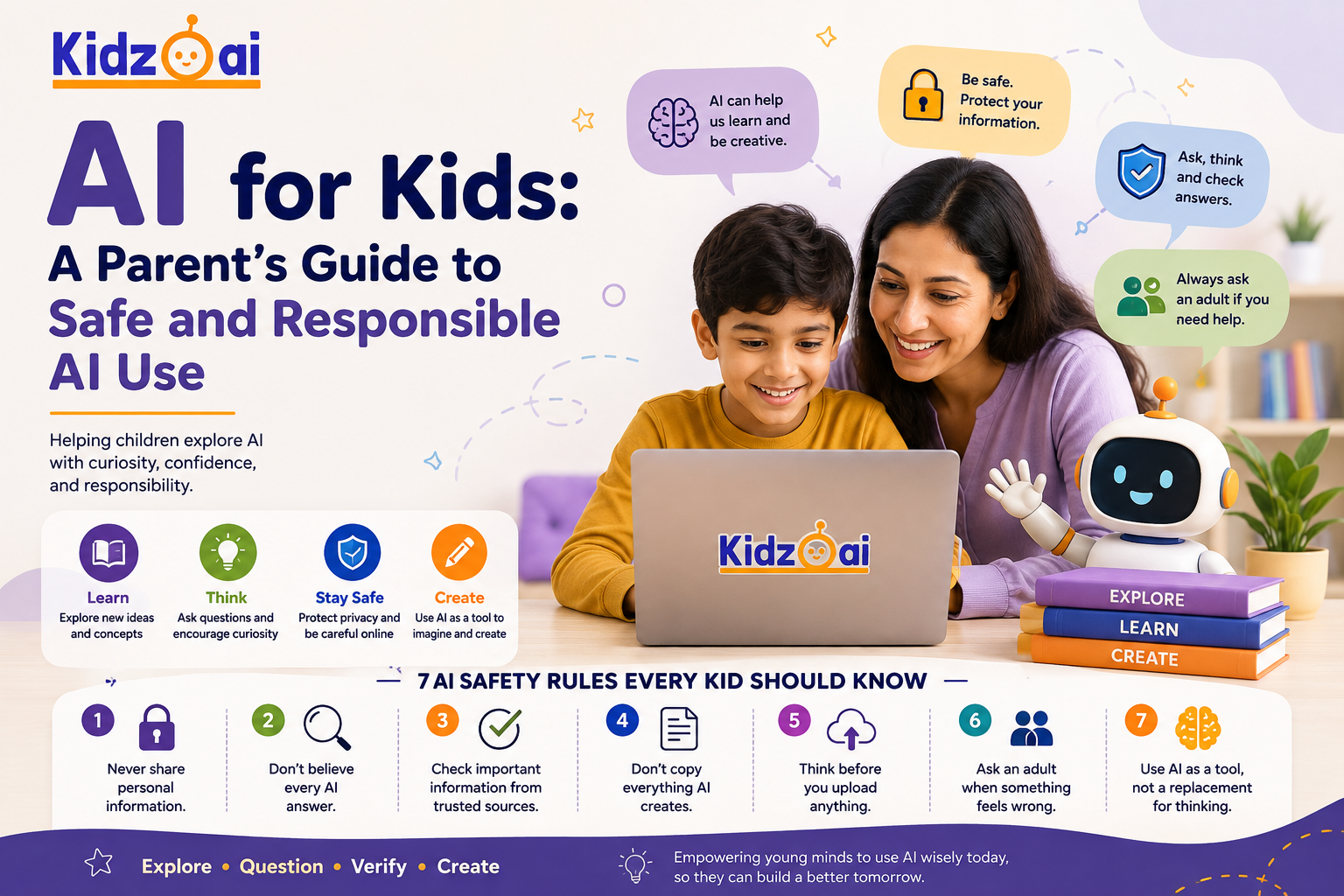
7 AI Safety Rules Every Kid Should Know
If your child uses AI, these seven simple rules can provide a useful starting point.
1. Never Give AI Your Personal Information
Children should avoid sharing passwords, home addresses, phone numbers, precise locations, school details, identification information, or other sensitive information with AI tools.
2. Don't Believe Every AI Answer
Just because AI says something does not mean it is correct.
Teach children to ask themselves:
“How do I know this is true?”
3. Check Important Information
For schoolwork and important questions, children should verify information using trusted sources such as books, teachers, parents, or reliable educational resources.
4. Don't Copy Everything AI Creates
AI-generated content should support a child's own thinking, writing, creativity, or problem-solving rather than replace it.
5. Think Before You Upload
Before uploading a child's photograph, school project, document, or other personal material, parents should check the AI service's privacy policy and understand how the information may be stored or used.
6. Ask an Adult When Something Feels Wrong
AI can sometimes provide confusing, unexpected, or inappropriate information. If something makes a child uncomfortable or confused, they should talk to a parent, teacher, or another trusted adult.
7. Use AI as a Tool, Not a Replacement for Thinking
The most important rule is simple:
Your brain should still be doing the work.
How Parents Can Introduce AI to Kids
You don't need to be an AI expert to help your child understand artificial intelligence.
Start with everyday examples and ask simple questions:
“Why do you think YouTube recommended this video?”
“How do you think your phone understands your voice?”
“Do you think AI can make a mistake?”
These conversations can turn everyday technology into opportunities for learning.
A simple approach parents can use is:
Explore → Question → Verify → Create
Explore: Let children discover what AI can do and understand its limitations.
Question: Encourage children to ask how and why something works.
Verify: Teach them to check important information instead of automatically trusting AI.
Create: Encourage children to use AI for creativity and learning rather than simply copying answers.
This approach can help children develop both technology confidence and critical thinking skills.
What Is the Best Age to Introduce Kids to AI?
There is no single age that is right for every child.
Parents should consider their child's maturity, the purpose of using AI, the type of AI tool, and the level of supervision needed.
It is also important to check the age requirements and terms of the specific AI service before allowing a child to use it.
Younger children may benefit more from exploring AI together with a parent or teacher, while older children may gradually learn to use appropriate tools more independently.
The goal should be guided learning rather than unrestricted access.
The Future of AI for Kids
AI is likely to become an increasingly common part of education, creativity, and everyday technology.
The most important skill children will need isn't simply knowing which AI tool to use. It is learning how to think while using AI.
Children need to learn how to question AI, verify information, protect their privacy, and use technology creatively.
Neither completely avoiding AI nor giving children unlimited access is necessarily the answer.
The middle path is to teach children how to use AI responsibly.
At KidzoAI, our goal is to make AI easier for children and parents to understand. Through simple explanations, activities, and practical guidance, we want to help children become curious learners while developing the judgment and skills they need to use technology safely.
Frequently Asked Questions About AI for Kids
Is AI safe for kids?
AI can be useful for children when it is used appropriately and with suitable guidance. Parents should consider the child's age and maturity, check the specific tool's age requirements, and teach children about privacy, misinformation, and responsible technology use.
What is AI for kids?
AI for kids means introducing children to artificial intelligence in a simple, understandable, and age-appropriate way. It includes explaining what AI is, where children encounter it, how it works at a basic level, and how to use it responsibly.
Can kids use AI for learning?
Yes. AI can support learning by explaining difficult concepts, creating practice questions, helping with brainstorming, and providing different explanations. Children should remain actively involved in the learning process instead of depending on AI to do the work for them.
Should kids use AI for homework?
AI can sometimes be used as a learning aid, depending on the school's policies and the requirements of the assignment. Children can use AI to understand concepts, brainstorm ideas, or practice. However, they should not simply copy AI-generated answers and present them as their own work.
What should kids never share with AI?
Children should avoid sharing sensitive information such as passwords, home addresses, phone numbers, precise locations, identification details, private photographs, or other personal information. Parents should encourage children to think carefully before uploading any personal content to an AI service.
Final Thoughts
AI for kids should not be only about teaching children how to use AI. It should also be about teaching them when to question it, when to verify it, and when to step away from it.
AI can support learning and creativity, but there are things children bring to the table that AI cannot replace: curiosity, judgment, critical thinking, creativity, and human connection.
The smart approach is neither to panic about AI nor to blindly embrace it.
Instead:
Explore it. Question it. Verify it. Create with it.
That is the kind of AI literacy every child deserves.