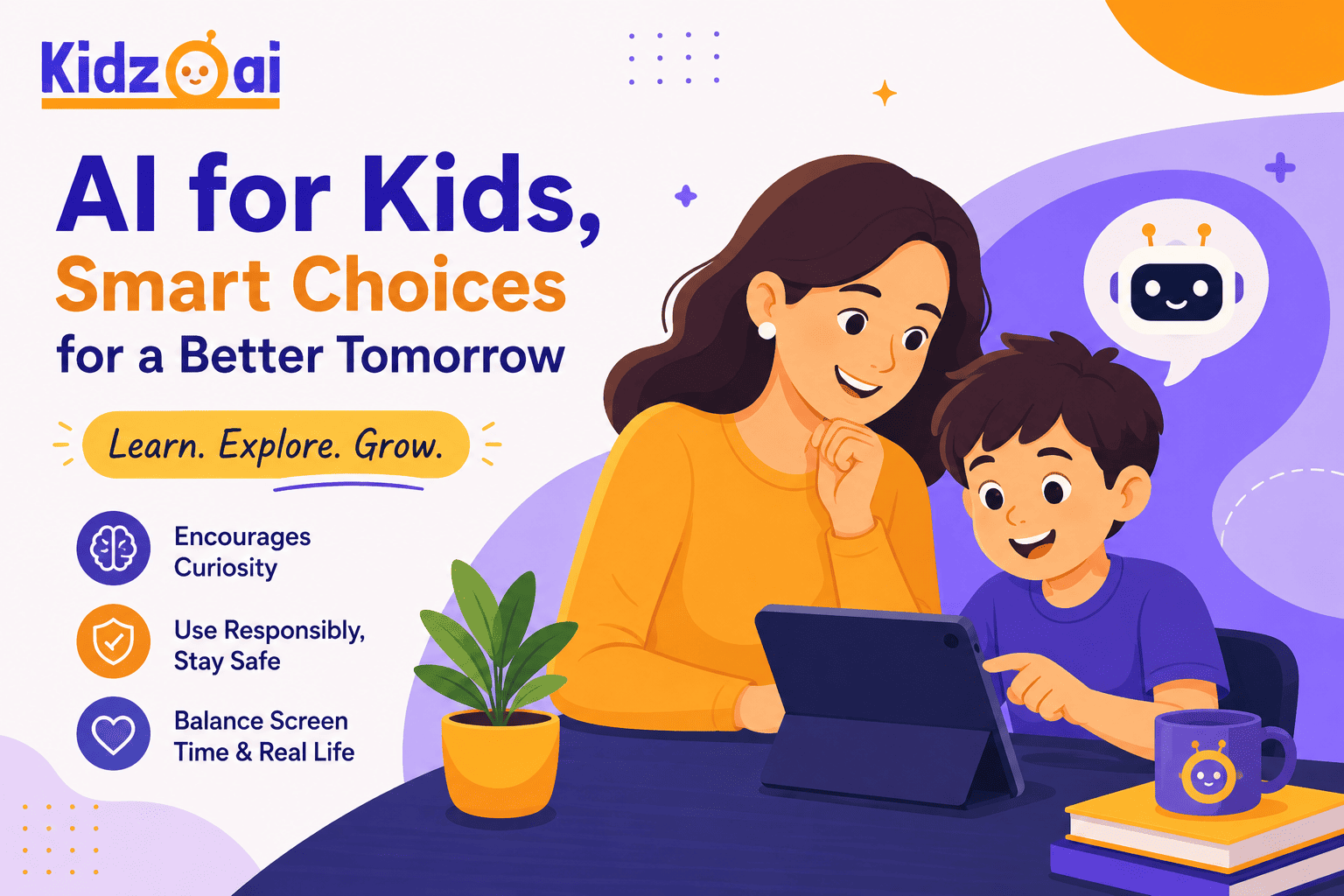
Artificial intelligence is becoming part of children's everyday lives. From educational apps and search engines to chatbots and creative tools, kids are increasingly interacting with AI—sometimes without even realizing it.
That naturally raises a question for parents: How much AI screen time is too much?
The answer isn't simply a number of minutes or hours.
When it comes to AI for kids, parents need to look at the bigger picture. What is the child doing on the screen? Are they learning, creating, exploring, or simply consuming content? Is AI helping them think, or is it doing all the thinking for them?
AI can be a useful learning companion, but it should not replace sleep, physical activity, family time, friendships, reading, or a child's own curiosity.
Does AI Count as Screen Time?
Yes. If a child is using an AI tool on a phone, tablet, laptop, or computer, it is screen time.
But that doesn't mean every type of screen time has the same value.
Consider two children. One spends an hour watching random videos. Another spends an hour asking questions about space, practising maths, creating a story, or learning how to code with an AI tool.
Both have spent an hour looking at a screen, but their experiences are very different.
This is why parents should look beyond the clock. The purpose, quality, and context of screen use matter too.
For example, a child using AI to understand a difficult science concept may be engaged in active learning . A child repeatedly asking AI to complete homework without understanding it is having a very different experience.
The goal isn't to label all AI screen time as good or bad. It is to help children develop healthy habits around technology.
Why AI Screen Time Deserves Special Attention
AI is different from many traditional digital activities because it can interact directly with a child.
A child can ask a question, receive an answer, ask for an explanation, request an example, and continue the conversation. That makes AI highly engaging.
It also means children need to understand that AI isn't automatically correct.
Parents introducing AI for kids should think about both the opportunities and the responsibilities that come with it.
AI can help children explore subjects, practise skills, generate ideas, and understand difficult concepts. At the same time, children need guidance around privacy, misinformation, age-appropriate use, and responsible technology habits.
If you're introducing AI to your child for the first time, our guide on safe AI use for kids is a useful place to start.
What Are the Benefits of AI for Kids?
Used thoughtfully, AI can make learning more interactive.
Imagine a child struggling to understand fractions. Instead of simply reading the same explanation again and again, they could ask an AI tool for a simpler explanation or a real-life example.
A child interested in dinosaurs could ask questions and then use the answers as a starting point for further research.
Another child could use AI to brainstorm a story, practise vocabulary, create quiz questions, or explore basic coding.
These experiences can encourage children to ask more questions and explore subjects that interest them.
The important distinction is this:
AI should support a child's learning—not replace the learning process.
If a child uses AI to get every answer without attempting to solve problems themselves, the technology may actually reduce opportunities to practise independent thinking.
When Can AI Screen Time Become a Problem?
AI becomes concerning when it starts pushing aside other important parts of childhood.
For example, parents may want to pay attention if AI use consistently replaces:
- Sleep
- Outdoor play
- Physical activity
- Reading
- Family conversations
- Face-to-face friendships
- Creative activities away from screens
- Independent problem-solving
The issue isn't necessarily that a child spent 45 minutes using AI. The bigger question is what happened during those 45 minutes—and what the child didn't do because of them.
A healthy routine gives children room for both digital and offline experiences.
5 Things Parents Should Consider
1. Look at the Activity, Not Just the Clock
Instead of asking only, "How long has my child been online?", ask:
"What are they actually doing?"
Are they learning something? Creating something? Solving a problem? Exploring a genuine interest?
Or are they simply using AI because they don't know what else to do?
This small change in perspective can make screen-time conversations much more useful.
2. Set Clear Boundaries
Children still need boundaries when using educational technology.
Simple family rules can help:
- Keep devices away during meals.
- Avoid screens close to bedtime.
- Take regular breaks.
- Make time for outdoor activities.
- Finish important schoolwork before recreational screen use.
- Keep some parts of the day completely screen-free.
The right balance will look different for every family.
3. Teach Kids Not to Believe Everything AI Says
This may be one of the most important lessons children can learn.
AI can produce answers that sound confident even when they are wrong.
A child who assumes, "AI said it, so it must be true," can easily pick up incorrect information.
That's why children should learn to pause and ask:
"Could this be wrong?"
"Where can I verify this?"
"Does this answer make sense?"
Parents can learn more about how AI can give incorrect information and use those examples to teach children why AI-generated answers should sometimes be checked.
The habit of questioning AI is more valuable than simply teaching children how to write better prompts.
4. Protect Your Child's Privacy
Children may not always understand what information should remain private.
Teach them never to share things such as:
- Passwords
- Home addresses
- Phone numbers
- Exact locations
- Personal identification details
- Private photographs
- Sensitive school information
Parents should also think carefully before allowing children to upload personal photos, documents, or other private material to an AI service.
Children need to understand that "just asking AI" doesn't mean every piece of information is safe to share.
5. Watch How Your Child Responds to Technology
Sometimes behaviour can tell parents more than screen-time statistics.
Does your child become extremely upset whenever they have to stop using an AI tool?
Are they staying up late to use it?
Do they avoid outdoor play or hobbies they previously enjoyed?
Are they asking AI to do almost all of their schoolwork?
These aren't reasons to panic, but they are good reasons to step back and reassess the routine.
How Can Parents Create a Healthy AI Routine?
One simple approach is:
Explore → Question → Verify → Create → Disconnect
Explore
Let children discover what AI can do. Ask questions together and explore topics they're genuinely interested in.
Question
Encourage them to think about how AI produced an answer and whether the answer makes sense.
Verify
For important information, especially schoolwork, encourage children to check reliable sources, books, teachers, or parents.
Create
Use AI as a starting point for stories, projects, ideas, coding, or other creative activities—but let the child contribute their own thinking.
Disconnect
Once the activity is finished, put the device away.
This final step is easy to overlook. Children need opportunities to take what they've learned from the screen and experience the real world.
For example, if a child uses AI to learn about plants, they could go outside and identify plants themselves. If they use AI to learn coding, they could build a small project instead of simply copying AI-generated code.
That's when technology becomes part of learning rather than the entire learning experience.
Should Parents Limit AI Completely?
For most families, completely banning AI may not be the most useful approach.
AI is becoming part of education, creativity, communication, and many everyday technologies. Children will likely encounter it whether or not they use an AI chatbot at home.
What matters is whether they know how to use it responsibly.
At the same time, unlimited access isn't ideal either.
Children need age-appropriate tools, supervision when necessary, clear boundaries, and an understanding of AI's limitations.
The goal should be guided use rather than unrestricted access.
AI Screen Time vs. Traditional Screen Time
It can help to think about screen activities in terms of what they require from the child.
| Activity | What the Child Is Doing |
|---|---|
| Watching random videos | Mostly consuming |
| Watching an educational lesson | Learning |
| Asking AI to explain a concept | Exploring |
| Asking AI to complete homework | Outsourcing |
| Using AI to brainstorm a story | Creating |
| Checking AI's answer against another source | Thinking critically |
| Using AI and then applying the idea offline | Learning through action |
This doesn't mean one category is always good and another is always bad.
It simply shows why the quality of screen time matters.
The Bottom Line for Parents
The conversation around children and AI shouldn't be reduced to "How many hours of screen time are allowed?"
A better question is:
"What is my child gaining from this screen time?"
AI can help children learn, explore, create, and become more curious. But it works best when children remain active participants in the process.
Parents can encourage healthy AI habits by setting boundaries, protecting privacy, checking information, encouraging independent thinking, and making sure technology doesn't replace real-world experiences.
Most importantly, children should understand that AI is a tool—not a replacement for their own brain.
The future of AI for kids shouldn't be about giving children more screen time. It should be about helping them make better use of the technology they already encounter.
Let them explore. Let them question. Let them create. And just as importantly, let them switch the screen off and experience the world around them.
Frequently Asked Questions
Is AI considered screen time for kids?
Yes. If a child uses an AI tool through a digital device, it is screen-based activity. However, parents should also consider what the child is doing during that time rather than focusing only on the number of minutes.
Is AI safe for kids?
AI can be useful for children when used appropriately and with suitable guidance. Parents should consider the child's age, the specific tool being used, privacy settings, and the possibility of incorrect or inappropriate information.
How much AI screen time should kids have?
There isn't one universal number that works for every child. Parents should consider the child's age, routine, schoolwork, sleep, physical activity, and other responsibilities. The quality and purpose of AI use matter alongside duration.
Can AI help children learn?
Yes. AI can explain concepts, generate practice questions, support brainstorming, help children explore interests, and provide different explanations. However, children should remain involved rather than allowing AI to do all the thinking for them.
How can parents teach kids to use AI responsibly?
Start with simple rules: don't share personal information, question AI-generated answers, verify important information, follow school rules, and use AI as a learning and creative tool rather than a replacement for independent thinking.